A roof framing plan is a top-down structural drawing of the roof system and its support. Depending on the project, it may identify rafters, trusses, joists, beams or frames; ridges, hips, and valleys; bearing points; roof openings; slope information; and references to member, connection, and bracing details.
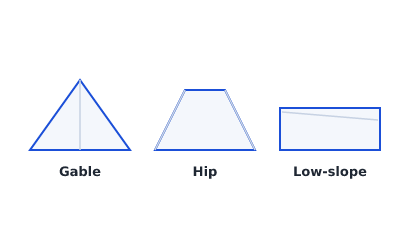 Three common roof types: gable, hip, and flat
What a roof framing plan shows
- Structural system: rafters, trusses, joists, frames, or other members, with the applicable type, direction, spacing, and references.
- Ridge: the line at the top where opposing roof slopes meet.
- Hips and valleys: the sloping lines where roof planes intersect at outside and inside corners.
- Beams and supports: structural ridge beams where used, other supporting beams, walls, columns, and bearing points.
- Openings: skylights, chimneys, and access hatches, framed with headers and trimmers.
- Annotations: member callouts such as
2x10 RAFTERS @ 16" O.C., spans, pitch, and a title block.
Many of these reuse the conventions in framing plan symbols: direction arrows, member callouts, bearing emphasis.
Rafters vs. trusses
Many residential pitched roofs use conventional rafters or prefabricated trusses, but those are not the only possible roof systems:
| Rafters (stick-framed) | Trusses | |
|---|---|---|
| What | Individual sloping members cut and framed on site, commonly 2x6 through 2x12 | Pre-engineered triangulated assemblies |
| Support concept | Depends on walls, ties, ridge-board or structural-ridge details, and any purlins or beams | Uses the bearing locations and restraints defined by the engineered truss design |
| Plan shows | Rafter direction, spacing, ridge and roof-plane members, plus detail references | Truss marks, placement, orientation, bearing, girder trusses, and bracing references |
Which system is used drives how the plan reads and where the loads land. See rafters vs. trusses for the full comparison.
Common roof types
- Gable: two slopes meeting at a ridge; the simplest pitched roof.
- Hip: slopes on all sides, meeting at hips and a ridge. Compared in gable vs. hip roof framing.
- Flat (low-slope): describes roof geometry, not one framing system. A joisted low-slope roof can resemble a floor framing plan, while other projects use rafters, trusses, steel, concrete, or another system. See the flat roof framing plan guide.
The pitch and slope affects geometry, covering, drainage, and loads, but does not by itself decide the structural system.
Laying out a roof framing plan
The decisions echo a floor plan, with roof-specific additions:
- Set the roof footprint (the plan outline of the roof).
- Identify the intended structural system and its authoritative design source.
- Coordinate member or truss direction, spacing, and bearing locations. Rafters and trusses are usually set at 16" or 24" on center, but the design controls.
- Trace supports and reactions to the structure below.
- Mark the ridge, hips, and valleys for a pitched roof.
- Coordinate openings and rooftop items such as skylights, chimneys, hatches, drains, ducts, and equipment.
- Annotate spacing, pitch or slope, member or truss references, bracing and connection details, and unresolved items.
Where an online tool helps
When a preliminary low-slope concept uses repeated joists, Framing Plan can generate the plan-view field and coordinate supports and openings. For other roof systems, it can still help with footprint and annotation, but it does not produce rafter calculations, engineered truss designs, drainage calculations, or connection and bracing design.
Keep it preliminary
Roof structures are project- and location-specific. A roof framing plan drafted in the app is a preliminary layout aid, not a substitute for the structural design, engineered truss package where applicable, roof-covering requirements, drainage design, and approvals required for the project. In the US, roof and ceiling framing sits in IRC Chapter 8, but the code adopted in your jurisdiction may amend it, so verify against the local edition.
Try it
For a flat or low-slope roof, draft the framing in your browser today. Open the framing studio to start, then read the flat roof framing plan guide or the broader framing plan overview.