A second floor framing plan documents one upper-floor sheet: the level and datum, joist fields, beams, stairwell and other floor openings, assumed support lines, dimensions, and references. Its special coordination task is to show where that level sends its reactions down to the first floor below.
In US practice the floor at grade is the first floor, so a second floor framing plan frames the floor you walk on upstairs. If you are coordinating the first floor, second floor, and roof as one drawing set, use the separate two-story home framing guide.
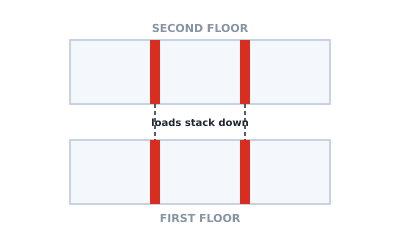 Second floor bearing walls stacking over support on the first floor below
How a second floor is supported
Second floor joists span between bearing points. In a typical house that means the exterior walls plus either an interior bearing wall or a beam somewhere in the middle, because a single joist rarely spans the full width of the house. A callout such as 2x10 JOISTS @ 16" O.C. tells a framer the member and the spacing, and the span arrow tells them which two lines of support the joists land on.
The part that matters most on an upper floor is what happens underneath. Every bearing point on the second floor has to carry down through the first floor and into the foundation. Where a second floor bearing wall sits directly over a first floor bearing wall, the load path is simple. Where it does not, the load has to be picked up by a beam or a transfer, and that is a structural design problem rather than a drafting one.
Information to gather before drawing
Start with current backgrounds for both the second floor and the first floor below. Confirm the level name, overall footprint, stair and mechanical openings, walls and beams below, columns, and any roof or wall loads that may land on the second floor. Record unknown or concealed conditions as unresolved. Do not fill them in from appearance.
Show one level unambiguously
An upper-floor sheet should let a reviewer answer these questions without guessing:
- Which exact level and datum does the drawing represent?
- Where are the separate joist fields, and what direction and spacing is assumed for each?
- Which walls, beams, or columns are assumed to support the member ends?
- Where are the stairwell, shafts, and penetrations that interrupt the floor?
- Which tags lead to member schedules or opening details, and which items still need design?
Use a consistent origin, grid, or aligned background so the second floor sheet can be compared with the first floor below. See structural grids and columns when the project uses formal setting-out lines.
Joist direction and spacing
The shorter clear span is a useful initial layout, not a rule. Check candidate directions against actual supports below, stair geometry, mechanical runs, floor assembly depth, cantilevers, and the intended joist system. Standard US spacings are 12, 16, 19.2, and 24 inches on center, and which one works for a given member and span comes from the applicable span table or manufacturer information. See floor joist spacing explained. Direction helps identify the supports for that joist field. It does not classify every wall.
Stair openings
The stairwell is a major floor opening shared by two levels. Place it from the coordinated background, then show the interrupted joists and the intended framing zone around the hole. Headroom, landings, guards, connections, and the final header and trimmer joist design are not solved by drawing a rectangle. They need the relevant architectural and structural details.
A workflow for a second floor
- Set the correct second floor footprint, datum, and drawing title.
- Overlay or compare the verified supports on the first floor below.
- Lay out separate joist fields and label the assumed direction and spacing.
- Add the stairwell and other floor openings from the current background.
- Mark support assumptions, offsets, transfers, and unknowns for review. Do not create unverified members to make the picture close.
- Add dimensions, tags, revision, and preliminary status, then export.
The per-step detail is in how to draft a preliminary floor framing plan, and the whole-house picture is in floor framing plans for a two-story home.
Keep it preliminary
The app's second floor drawing is a preliminary layout aid. Reactions, transfers, member sizes, vibration and deflection, openings, bearing, connections, and the support capacity below all need project-specific structural verification before construction use.
Try it
Draft your second floor over the same footprint as the first floor and check that the bearing lines stack. Open the framing studio to lay out a second floor framing plan in the browser.