A floor plan is an architectural drawing of space and use; a floor framing plan is a structural drawing of the members and supports for one floor level. They can share a footprint and openings, but they have different sheet titles, symbols, audiences, and approval information.
If you want the full primer on the structural drawing itself, start with the complete floor framing plan guide.
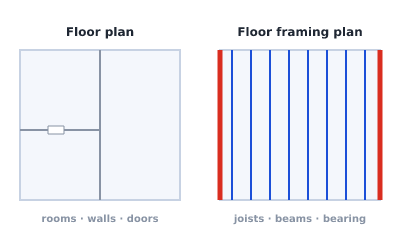 Floor plan versus floor framing plan, shown side by side
The short answer
- A floor plan is an architectural drawing. It shows rooms, walls, doors, windows, stairs, and fixtures as seen looking straight down at the finished space.
- A floor framing plan is a structural drawing. It shows the joists, beams, bearing walls, columns, and openings that carry the floor: the skeleton beneath the finish.
Same building, same viewpoint from above, but one draws the space and the other draws the support.
Side by side
| Floor plan | Floor framing plan | |
|---|---|---|
| Discipline | Architectural | Structural |
| Shows | Rooms, walls, doors, windows, fixtures | Joists, beams, bearing walls, columns, openings |
| Answers | "How is this space arranged and used?" | "How does this floor stand up?" |
| Primary audience | Owners, designers, planners | Framers, builders, structural reviewers |
| Typical callouts | Room names, door swings, dimensions | Joist direction and on-center spacing, member sizes, bearing notes |
How they relate
The two drawings are not independent: they have to agree. Every decision on one constrains the other:
- A stair opening drawn on the floor plan must be framed on the framing plan, with headers carrying the interrupted joists.
- A load-bearing wall that the framing plan relies on cannot be casually moved on the floor plan without rethinking the structure.
- The overall dimensions must match exactly, or the building does not close.
This is why coordination between architectural and structural drawings matters. A change to the layout ripples into the structure, and vice versa.
Which one do you need?
If you are arranging a space, deciding where rooms go, how big they are, and where doors and windows sit, you are working on the floor plan. If you are working out how that floor is supported, which way joists run, where beams and bearing walls fall, and how openings are framed, you need a floor framing plan.
Projects commonly need both, and they should develop through coordination rather than a rigid one-way sequence. Structural floor depth, support positions, grids, and transfers can affect rooms and openings; architectural changes can in turn alter the framing. To interpret a structural sheet, use how to read a floor framing plan.
Draft the structural side in your browser
Once your layout is set, you can sketch the preliminary framing (joists, beams, openings, dimensions) directly over the footprint and export it for review. Open the framing studio to try it, free and in the browser.